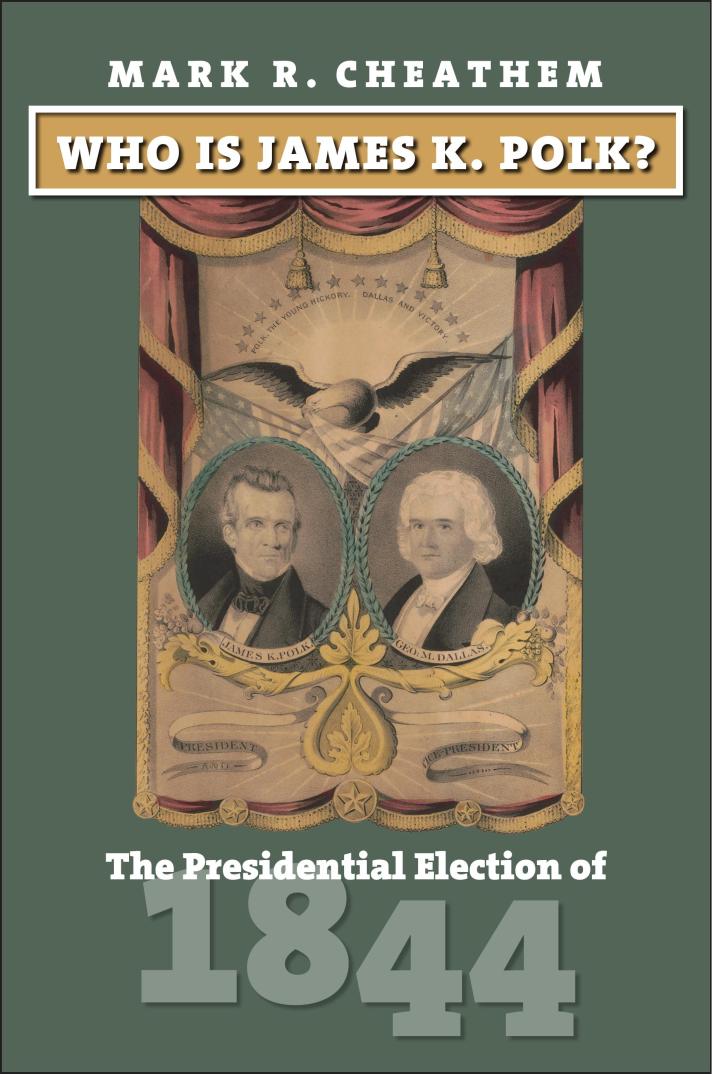
I first had the idea for this book shortly after
Andrew Jackson, Southerner was published. During a visit to Rhodes College in early 2014, Mike Nelson mentioned the 1844 election as a potential volume in the University Press of Kansas’
American Presidential Elections series. Even though the election was not on the original list of planned volumes for the series, UPK found my proposal persuasive and issued an advance contract.
My working title was “The Dark-Horse Campaign of 1844: Slavery, Westward Expansion, and Presidential Politics.” My proposed thesis was that the contest was pivotal in setting the tone for the antebellum presidential campaigns that followed it. Prior to 1844, no presidential election emphasized slavery as a major political issue; following 1844, every presidential campaign through 1860 focused on slavery. This change, I argued, was due in large part to the attention that James K. Polk and the Democratic party paid to slavery because of the debate over Texas’ proposed annexation to the United States.
My original submission deadline was 2018, which proved overly ambitious. I was working on book manuscripts that eventually became
Andrew Jackson and the Rise of the Democrats (and the revised paperback edition,
Andrew Jackson and the Rise of the Democratic Party) and
The Coming of Democracy: Presidential Campaigning in the Age of Jackson. I also took on the task of producing the second edition of
Historical Dictionary of the Jacksonian Era and Manifest Destiny. There was
a small project about Martin Van Buren that fell into my lap and took up time as well. And if that weren’t enough, the disruption caused by the onset of the COVID-19 pandemic proved a significant challenge to finishing the 1844 election book.
The editors at UPK may not agree, but the delays—self-inflicted and unavoidable alike—turned out to be a positive, in my opinion. Finishing The Coming of Democracy in particular reoriented my thinking about the nature of Jacksonian politics. Instead of the traditional political narrative that I had privileged in previous books, my exploration of cultural politics between 1824 and 1840 provided a richer understanding of what motivated both politicians and voters in this era. The theme of cultural politics appears throughout Who Is James K. Polk? and takes center stage in chapter 5.
Working on the
Papers of Martin Van Buren also produced unexpected benefits. While Van Buren did not win the Democratic Party’s presidential nomination in May 1844, his frontrunner status invested any decision he made about a potential campaign issue with heightened importance. This proved true with Texas annexation, an issue that exploded in early 1844 and opened the door for a strong supporter of immediate annexation
—someone like James K. Polk
—to step in to take control of the party’s future.
Ultimately, I arrived at the same conclusion with which I started: the 1844 presidential election was an overlooked, yet crucial, step move toward the Civil War, and slavery and annexation played important roles. But by emphasizing the importance of other issues, such as cultural politics, nativism, and the additional campaigns of abolitionist James G. Birney, the Mormon prophet Joseph Smith, and President John Tyler, I think the book became much stronger. I hope you think so too.
Published by Mark R. Cheathem
Historian and author
View all posts by Mark R. Cheathem

 Jacksonian America: Society, Personality, and Politics